Guide
How to Market a Lovable App: Get Your First Users After You Launch
Built an app with Lovable but don't know how to get users? This practical launch and marketing playbook shows solo founders and small teams what to do next — from finding the first customers to creating content, getting discovered and doubling down on what works.
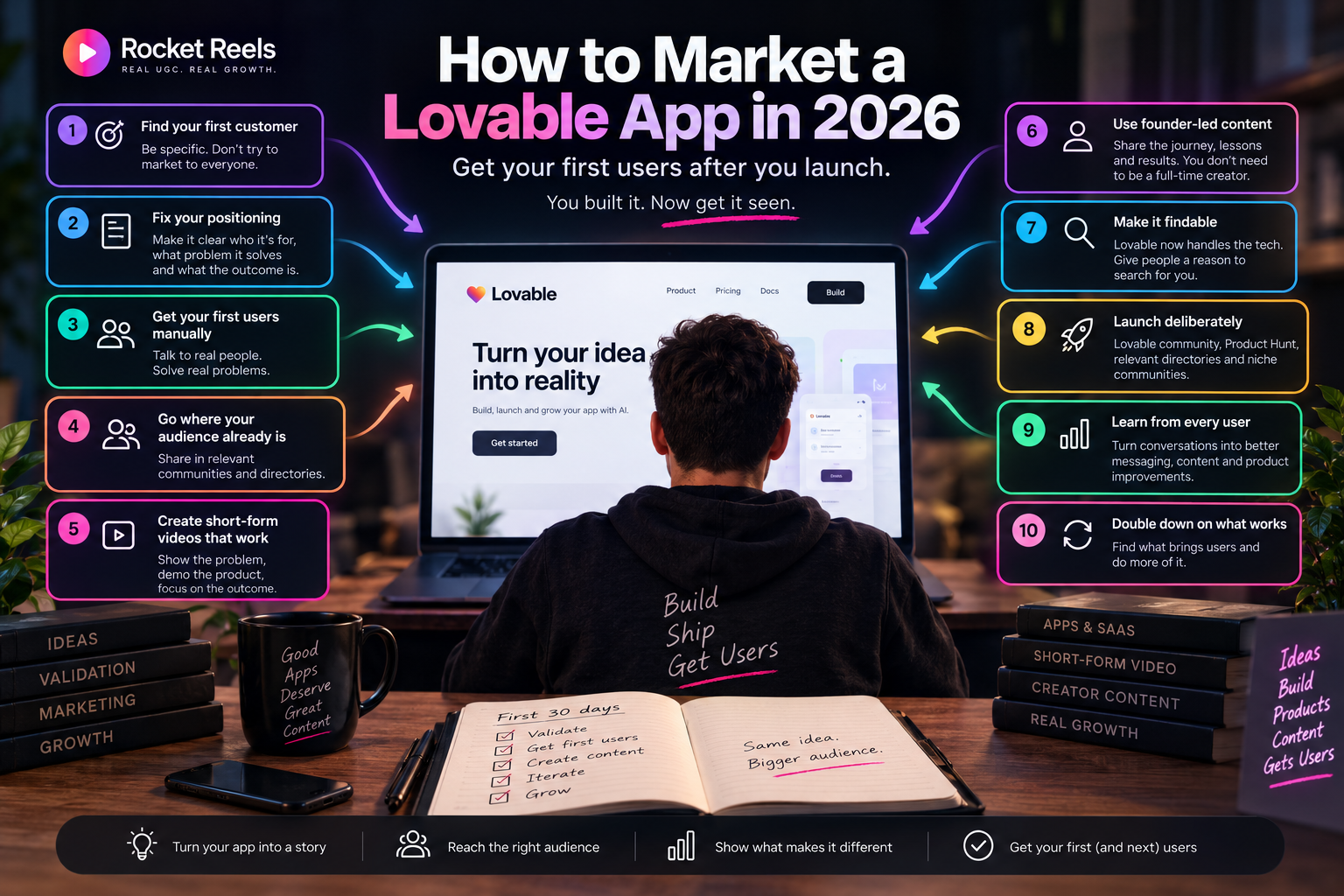
You built the app. It works. You've fixed the obvious bugs, connected your domain, tested the signup flow and finally pressed publish.
Then something much less exciting happens. Nothing.
No sudden wave of users. No queue of customers. No algorithm magically discovering what you made.
This is the point where a lot of first-time app founders realise that building and distribution are two different jobs.
Lovable has made the first job dramatically easier. A solo founder or small team can now turn an idea into working software without assembling the kind of development team that would once have been required.
But someone still has to make the right people care.
Lovable itself increasingly recognises this problem. In May 2026 it introduced new discoverability capabilities under the message “Building is just the beginning,” noting that getting a solution in front of the right audience may never have been harder.
And the problem shows up repeatedly among builders themselves. Recent Lovable community discussions include founders who have finished their product and immediately ask how to market it, which channels actually work, and how to get the app in front of the right people.
If that's where you are now, this guide is for you.
You do not need a 30-person marketing department. You need to identify a small group of people with a real problem, explain why your product matters, get it in front of them, learn what gets a response, and repeat what works.
Here's the order we'd start in.
You finished building. Now the job changes.
The speed of modern app building can create a misleading expectation. When a product goes from idea to working software unusually quickly, it's easy to expect growth to happen at the same speed.
But product creation and customer acquisition operate differently.
Lovable reported in May 2026 that more than 200,000 projects were being shipped on its platform every day. That is an extraordinary amount of new software competing for attention.
The implication for a small founder is simple: being able to build something is no longer enough to make it noticeable.
Your next questions change from “What feature should I build?” to:
- Who needs this?
- Where can I find them?
- What would make them stop and pay attention?
- Why would they choose this instead of doing nothing or using something else?
- What can I show them that makes the value obvious?
Step 1 — Find your first customer, not your total addressable market
A new founder often describes their audience far too broadly.
- “This is for small businesses.”
- “This is for creators.”
- “This is for anyone who wants to save time.”
Those descriptions make marketing harder because they don't tell you where to find the person or what to say to them.
For the first 10 users, narrow the audience aggressively.
| Instead of | Try |
|---|---|
| Small businesses | Independent UK estate agents who manually create property social posts |
| Creators | YouTube creators who turn long videos into Shorts every week |
| People who need invoices | Self-employed tradespeople who currently create invoices manually after work |
You can expand later. For now, specificity gives you:
- somewhere to find people
- a recognisable problem
- language they already use
- clearer content ideas
- easier outreach
- better feedback
Write this sentence
“My app helps [specific person] do [specific job] without [specific pain or current method].”
If you can't complete that sentence clearly, marketing the app will be difficult regardless of the channel you choose.
Step 2 — Make your positioning understandable in five seconds
Before sending traffic anywhere, look at your homepage as if you have never seen the product before.
Can a stranger quickly answer:
- What is this?
- Who is it for?
- What problem does it solve?
- What outcome will I get?
- What should I do next?
A clever product name or generic headline such as “Work smarter with AI” rarely answers those questions. For an early-stage app, clarity usually beats cleverness.
Use this simple structure:
| Element | What it should say |
|---|---|
| What it does | A plain-English description of the product |
| Who it's for | The person or business with the problem |
| Outcome | What becomes faster, easier, cheaper or possible |
| Proof | A demonstration, example, result or credible reason to believe you |
| Action | One obvious next step |
Step 3 — Get the first 10 users manually
At the beginning, you do not need thousands of impressions. You need conversations.
Find people who genuinely experience the problem your app solves. Depending on the product, that might mean:
- direct messages
- personalised emails
- local businesses
- niche Facebook groups
- Reddit discussions
- Slack or Discord communities
- professional forums
- people in your existing network
The goal isn't to blast a link at strangers. It is to understand the problem and invite relevant people to try a possible solution.
A useful early conversation might be: “I've been working on something for [specific problem]. I noticed you mentioned [problem or context]. Would you be willing to try it and tell me where it falls short?”
That can produce more useful information than thousands of untargeted visitors.
Recent Lovable community discussions reflect this same challenge: builders repeatedly ask which channels actually produced their first 10–50 customers rather than simply generating traffic. These are individual accounts rather than measured research.
What you're trying to learn
For every early user, find out:
- Why did they try it?
- What did they think it did before signing up?
- What almost stopped them?
- What feature did they care about?
- What words did they use to describe the problem?
- Did they come back?
- Would they pay?
- Who else has the same problem?
Those answers become your marketing.
Step 4 — Go where your audience already is
Don't choose a marketing channel because another SaaS founder says it worked for them. Choose it because your customers are there.
If you're building software for accountants, the answer may be LinkedIn, accounting communities, professional groups and direct outreach. If you're building a consumer app for new parents, the answer may be TikTok, Instagram, parenting communities and relevant creators. If you're building for developers, Reddit, X, GitHub communities and technical content may matter more.
The product determines the channel.
| Audience | Possible places to start |
|---|---|
| B2B professionals | LinkedIn, industry communities, direct outreach, newsletters |
| Local businesses | Direct outreach, local groups, Facebook, industry associations |
| Creators | TikTok, Instagram, YouTube, creator communities |
| Developers | Reddit, X, GitHub, technical communities |
| Consumers | TikTok, Instagram, YouTube Shorts, relevant communities |
| Niche hobbyists | Specialist forums, Reddit, Facebook groups, creators |
These are starting points, not universal rules. Validate where your specific audience actually spends time before committing heavily to a channel.
Step 5 — Make short-form videos that show the problem and the product
Software has one major advantage when it comes to content: you can show it working.
A short-form video for an app doesn't need to look like a traditional software advert. And UGC for software doesn't require someone holding a physical product.
One of the most useful formats combines a human hook, a real screen demonstration and a clear outcome.
The person earns attention. The screen recording proves what the product does. The result gives the viewer a reason to care.
Format 1 — Problem → Demo → Result
| Timing | What happens |
|---|---|
| 0–3 seconds | “If you're still doing [painful task] manually, watch this.” |
| 3–8 seconds | Show the old or problematic workflow |
| 8–20 seconds | Show the app completing the task |
| 20–25 seconds | Show the result |
| 25–30 seconds | Clear next step |
Format 2 — Why I built this
Hook: “I built this because I was sick of…”
Then:
- show the problem
- explain the frustration
- reveal the app
- demonstrate it
- show the outcome
This is particularly natural for founder-led content.
Format 3 — Discovery
Hook: “I found a tool that…” or “I didn't know you could do this…”
Then immediately demonstrate the most visually satisfying part of the product.
Format 4 — Before → App → After
Show the slow, frustrating or expensive way, then the product doing the work, then the improved result. The contrast does much of the selling.
Format 5 — Specific audience hook
Start by identifying the viewer. For example:
- “If you run an Etsy shop…”
- “If you're a self-employed electrician…”
- “If you make YouTube videos…”
- “If you manage social media for clients…”
Specificity can make a small audience pay much more attention than a generic viral hook.
The important part isn't “going viral”
For a small app, 3,000 views from exactly the right potential customers can be more valuable than 300,000 views from people who will never use the product.
Judge the content by what happens after the view:
- profile visits
- website visits
- signups
- trials
- replies
- demos
- purchases
Not views alone. If you're weighing up what creator-led production costs before committing, our UK UGC pricing guide breaks down the typical price layers.
ROCKET REELS FOR APP FOUNDERS
You built the app. Let's turn it into content.
Tell us about your app and Rocket Reels will learn about your business and create a quick personalised demo video — then you can explore more high-performing short-form ideas for your product.
Step 6 — Use founder-led content without becoming a full-time creator
Founder-led content does not mean documenting every minute of your life. Your experience building the product gives you material that a generic company account does not have.
You can talk about:
- why you built it
- the problem that triggered the idea
- something a user taught you
- a mistake you made
- a feature people misunderstood
- before-and-after workflows
- how a customer uses it
- a surprising result
- a new feature and why it exists
- an opinion about the problem your industry faces
A recent Lovable community discussion included a founder reporting that much of their acquisition came from simply being where their audience already spent time — including Reddit, X and LinkedIn — and sharing what they were building, lessons and progress.
That is one founder's experience rather than proof that the same channels work for every product.
The principle is more useful than the channel: give people a reason to follow the journey as well as the product.
Step 7 — Make the app findable
SEO advice about Lovable can become outdated quickly. As of September 2026, it is no longer accurate to describe Lovable apps generally as client-only applications that search engines cannot properly read.
Lovable introduced major discoverability changes in May 2026. According to Lovable, new apps now ship with crawlable HTML, while existing apps received pre-rendered HTML snapshots for crawlers.
Lovable also provides:
- SEO review
- sitemap checks
- robots.txt checks
- metadata review
- canonical checks
- alt-text checks
- content-structure review
- Semrush-powered search research
- Google Search Console integration
- support for AI-search discoverability
That solves or assists with important technical foundations. It does not mean your app will automatically rank. Search engines still need useful public pages to find, understand and recommend.
Create pages people actually need
Depending on the product, useful pages might include:
- clear feature pages
- use-case pages
- genuine comparison pages
- templates
- calculators
- free tools
- original research
- tutorials
- examples
- answers to recurring customer questions
Do not create hundreds of near-identical pages simply because a keyword exists. Publish something because it deserves to exist for the person searching.
Step 8 — Launch deliberately
Publishing and launching are not the same thing. Publishing makes the app available. Launching gives people a reason to notice it now.
Lovable itself has historically encouraged builders to think about launch distribution rather than simply pressing publish.
Potential launch surfaces can include:
- your existing network
- relevant customer communities
- founder and build-in-public audiences
- Product Hunt when appropriate
- relevant directories
- niche newsletters
- creators in your market
- X
- Reddit where promotion is genuinely allowed and relevant
- industry communities
Do not post the same promotional message everywhere. Adapt the launch to the audience.
A founder community may care about how you built it. A customer community cares about the problem it solves. Those are different stories.
Step 9 — Turn every user conversation into marketing intelligence
Your first customers are not only users. They are research.
Keep a simple record of:
- phrases customers use
- objections
- questions
- alternatives they considered
- reasons they signed up
- reasons they didn't
- features they value
- outcomes they want
- moments that surprised them
Then recycle that intelligence.
| What you heard | Where it becomes marketing |
|---|---|
| Customer question | FAQ or article |
| Common objection | Landing-page section |
| Painful old workflow | Video hook |
| Customer result | Case study |
| Feature confusion | Product demo |
| Competitor mention | Comparison research |
| Repeated problem | New content angle |
Your customers can gradually tell you what your marketing should say.
Step 10 — Double down on what actually brings users
The temptation after launch is to attempt everything: SEO, TikTok, LinkedIn, Reddit, cold email, Product Hunt, influencers, ads, affiliates, partnerships, YouTube and newsletters.
Trying all of them badly makes it difficult to learn anything.
Instead, record where every meaningful user comes from. For the first month, a simple table may be enough:
| Channel | Visitors | Signups | Conversations | Paying customers | What we learned |
|---|---|---|---|---|---|
- If one channel produces conversations with the right people, give it more attention.
- If a type of video repeatedly produces site visits, make variations.
- If one search query starts generating qualified visitors, build around the topic.
- If a community produces nothing after genuine participation, don't keep using it because somebody else's playbook says you should.
Growth gets easier when you stop guessing.
A practical first 30 days after launching your Lovable app
| Week | Primary goal | Actions |
|---|---|---|
| Week 1 | Find the first customer | Define one narrow audience; fix positioning; identify 30 potential users; begin conversations; install and verify analytics |
| Week 2 | Learn | Get users into the product; interview them; record objections and questions; fix the biggest onboarding or positioning problems |
| Week 3 | Test distribution | Choose 1–2 channels where the audience already exists; publish product demonstrations; test several hooks and messages; continue direct conversations |
| Week 4 | Repeat evidence | Identify what produced qualified users; make variations of winning content; improve pages based on real questions; stop or reduce activities producing no signal |
The objective of the first month isn't to build a perfect marketing machine. It is to leave the month knowing more than you did when it started.
Ideally you should know:
- who responds
- what they care about
- what message works
- where they can be reached
- what makes them try the product
- why some become customers
- what you should test next
What should you spend money on?
For a solo founder, budget matters. Don't assume paid advertising should be the first move simply because the app is live.
Ads can amplify something that already makes sense. They can also amplify unclear positioning and send more people into a product that hasn't yet proven it converts.
Before spending heavily, try to establish:
- a clearly defined customer
- understandable positioning
- a working onboarding journey
- evidence that some people genuinely want the product
- at least one message or creative angle that gets attention
Then paid distribution becomes easier to evaluate. Potential early investments might include:
- creator and content production
- small controlled ad tests
- useful marketing tools
- targeted sponsorships
- niche creators
- relevant directories
- specialist help where you lack a key capability
Spend to accelerate learning, not to avoid it.
What if you hate marketing?
This is common among builders. Building gives immediate feedback — you change something and see the result. Marketing requires putting an idea in front of people who can ignore it. That feels different.
But marketing does not require becoming a stereotypical salesperson or full-time influencer. At the beginning, marketing can simply mean:
- Find someone with the problem.
- Understand it.
- Show them what you made.
- Listen to the response.
- Explain it better.
- Show the next person.
Content, SEO, outreach and advertising are ways of doing that at increasing scale. The underlying job remains the same.
Where Rocket Reels fits
Rocket Reels doesn't replace your entire marketing strategy. It solves a narrower problem: what short-form creative should we make, and how do we get it made?
For a solo founder or small team, that can be a meaningful bottleneck. You may know the product better than anyone but still have no desire to:
- spend every day looking for TikTok ideas
- recruit creators
- write hooks
- plan shots
- edit videos
- repeatedly start creative concepts from scratch
Rocket Reels starts with high-performing UGC and short-form creative already appearing on social. You choose the videos and formats you like. The creative direction can then be recreated around your own brand or product.
For an app, that may mean combining creator-led footage with screen recordings and a real product demonstration.
The goal isn't simply “make a UGC video.” It's to give a small business access to a repeatable source of creative ideas and production without needing an internal content team.
YOUR PRODUCT IS BUILT
Now show people why it matters.
Tell us what you've built and see how Rocket Reels can turn your app into short-form content designed around your business.
Frequently asked questions
How do I market an app built with Lovable?
Start by defining a narrow first customer and making your positioning clear. Then get early users manually, learn where that audience already spends time, demonstrate the product through relevant content, make the app discoverable through useful public pages, and measure which channels actually produce qualified users. Avoid trying every marketing channel simultaneously.
How do I get my first users for a Lovable app?
For most new apps, start manually rather than waiting for SEO or algorithms. Identify people who already experience the problem your app solves, talk to them directly, invite a small number to try the product and use their feedback to improve the positioning, onboarding and offer. Your first 10 users are as much a research exercise as an acquisition target.
Is Lovable good for SEO?
Lovable's search capabilities have changed significantly. As of September 2026, Lovable says new apps ship with crawlable HTML and provides SEO reviews, Semrush-powered research and Google Search Console integration. Those technical foundations can help search engines access and understand an app, but ranking still requires useful content, relevant pages, authority and genuine demand.
Should I launch my Lovable app on Product Hunt?
Product Hunt can be useful for some products, especially those relevant to its technology and early-adopter audience, but it should not be treated as a mandatory launch channel. A niche community containing your exact customer can be more valuable than a larger general launch audience. Choose launch channels based on where your target users actually are.
Should I run ads as soon as my app launches?
Usually it is worth learning from a small number of real users before spending heavily. Paid ads can amplify a clear proposition and working funnel, but they can also send more traffic to an app whose positioning or onboarding has not yet been validated. If you test ads early, keep the experiment controlled and treat it as a learning exercise.
Can UGC work for SaaS and apps?
Yes. UGC-style content for software does not require a physical product. A useful format combines a human or creator-led hook with a real screen recording, product demonstration and clear outcome. The content should show why the viewer should care and what the software actually does.
What should I post on TikTok or Instagram for my app?
Start with the customer's problem rather than a list of features. Useful formats include problem-to-demo videos, before-and-after workflows, founder stories, product discoveries, tutorials and audience-specific hooks. Measure website visits, signups and customers rather than judging content only by views.
Do I need to become a content creator to grow my app?
No. Founder-led content can help, but it does not require documenting your life or posting constantly. You can share product demonstrations, customer problems, lessons, results and the reasons behind what you built. You can also work with creators when you would rather not appear in the content yourself.
Methodology and editorial note
This guide was researched using current Lovable product documentation, official Lovable announcements and recent discussions from people building and marketing products with Lovable.
Lovable product and discoverability information was checked against sources available on 8 September 2026.
Community discussions are used as qualitative evidence of the questions and problems builders are reporting. Individual founder results are anecdotes, not guarantees that the same marketing channel will work for another product.
Marketing recommendations in this guide are Rocket Reels' editorial analysis based on those sources and general early-stage customer-acquisition principles.
Rocket Reels provides UGC and short-form creative services and therefore has a commercial interest in the content-production section of this guide. We have kept that recommendation limited to the part of the marketing process our product is designed to help with.
Marketing channels, Lovable features and search capabilities can change. Verify current platform functionality before relying on a specific feature.
Sources
- 1.Building is just the beginning: Introducing Discoverability — Lovable (accessed 2026-09-08)May 2026 discoverability launch, 200,000+ projects shipped per day, crawlable HTML and pre-rendering, Semrush and SEO-review capabilities.
- 2.Optimize your app for SEO and AI search — Lovable Documentation (accessed 2026-09-08)Current SEO/AEO capabilities, SEO reviews, Semrush-powered research, Google Search Console integration and technical search foundations.
- 3.A first look at the build economy — Lovable (accessed 2026-09-08)Context around the expansion of software building beyond traditional development barriers.
- 4.One year of Lovable: Welcome to the age of the builder — Lovable (accessed 2026-09-08)Historical scale and context around the growth of app creation on Lovable.
- 5.How to launch and get traffic to an app built with Lovable — Lovable (accessed 2026-09-08)Lovable's historical guidance that launching and acquiring users are separate from simply building and publishing an app.
- 6.Successful apps created with Lovable?? — Reddit — r/lovable (accessed 2026-09-08)Recent builder asking how to market and get users after finishing a Lovable project. Anecdotal community evidence only.
- 7.What marketing channels are actually working for products built on Lovable? — Reddit — r/lovable (accessed 2026-09-08)Founder asking which channels produce the first 10–50 customers after building with Lovable. Individual results are anecdotal.
- 8.What's actually moved the needle for marketing your vibe coded app? — Reddit — r/lovable (accessed 2026-09-08)Direct evidence of the “product works, now I need to get it in front of the right people” problem. Comments and results are anecdotal.
- 9.How do you plan to market your Lovable app in 2026? — Reddit — r/lovable (accessed 2026-09-08)Qualitative examples of channels Lovable founders are experimenting with, including community participation and founder-led content. Individual acquisition claims are anecdotal.
- 10.App marketing — Reddit — r/lovable (accessed 2026-09-08)Qualitative evidence that builders reach the post-build “how do I get eyes and customers?” problem.